
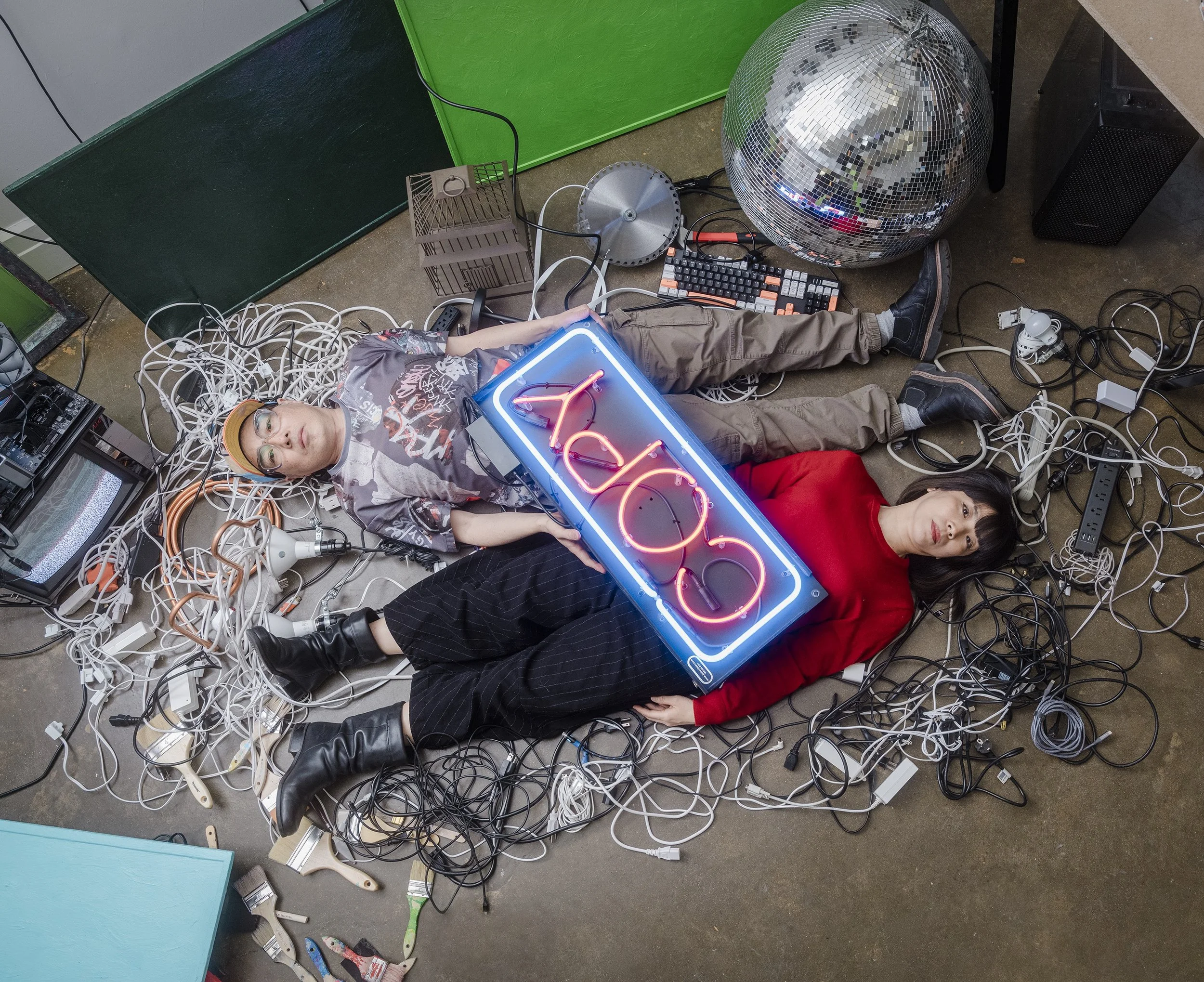
exonemo: Sembo (top) Yae (bottom). Photo by Fumi Nagasaka
How we feel right now: An interview with exonemo by Jesse Pearson
For nearly 30 years, the Japanese artist duo exonemo has made work about computers, the internet, and the people on the other side of the screen.
For their exhibition Terminal at NowHere (on view September 10 - November 7, 2026), Jesse Pearson spoke with the artist duo exonemo about their exploration of randomness through their work and the machine at the heart of the show: one that must decode random numbers drawn from water, knowing a hanging stone will fall if it succeeds.
Jesse: What attracts you to the idea of randomness at this particular time in history?
exonemo: We have been captivated by the allure of randomness since the very beginning of our nearly 30 years of practice in new media art. Computers can instantly translate randomness into expression, expanding the limits of our imagination. The internet further broadens our world by connecting us to random information and to the people behind it. Many of our early works openly celebrated random cut-ups, and at that time we placed great expectations on computers in this way.
J:Cut-ups in the classic, Beat Generation sense of Brion Gysin and William S. Burroughs?
e: Yes. Yet what computers truly excel at is the opposite of randomness: logical calculation. As computers and the internet have permeated society, our world has increasingly transformed into one of logic and acceleration. People now find themselves divided into bubbles of information, sorted by the “rational” judgments of algorithms. To break through this, perhaps we need to embrace a more absurd kind of randomness.
J: I love this idea.
e: If you think about it, most aspects of our identities are determined randomly: gender, race, which country or which era we are born into. This is much like in role-playing games, where a character’s parameters are randomly assigned at the start. Society values the choices we make with our own will but, paradoxically, we often cling more strongly to attributes we did not choose—to those determined by chance. We take pride in masculinity, or in national identity, for example. This suggests that human values are built as narratives on top of randomness, independent of self-awareness. In fact, the very ability to create meaning out of randomness may be one of the core capacities of being human. Art embodies this perfectly: Creativity lies in how we construct meaning from something that at first appears meaningless, like randomness.
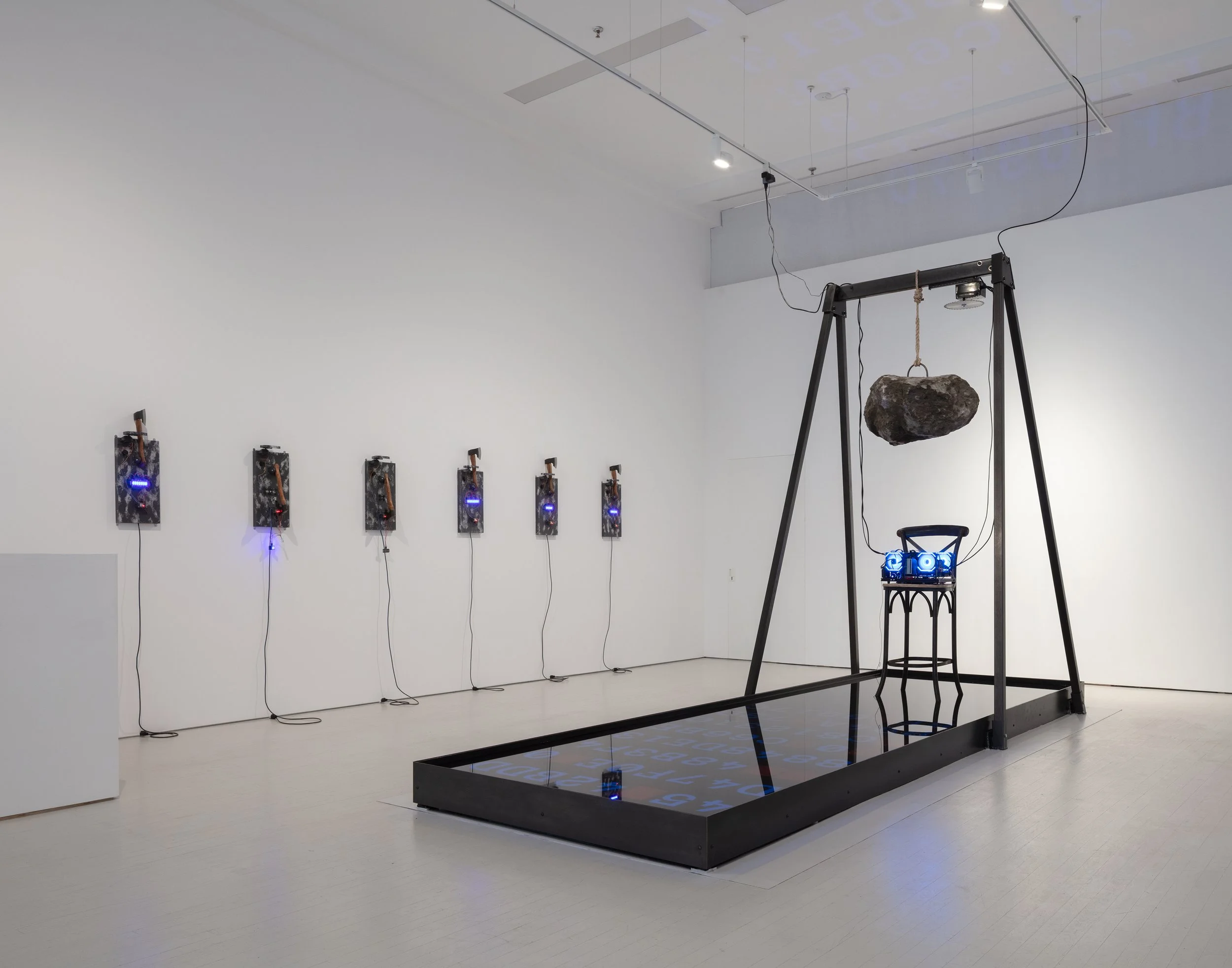
exonemo | Hatch/et, 2026, The Terminal, 2026
J: Where else do we see these ideas reflected today?
e: Another point worth mentioning is cryptocurrency. Its fundamental security relies solely on the difficulty of decoding sufficiently long random information. Usually, when people hear “random,” it implies something unreliable. But here it is the opposite: Because it is random, it is trustworthy, and vast sums of money are entrusted to it. The fact that so many people depend on this structure built upon randomness is fascinating to us. And, in truth, computers are not good at generating true randomness.
The random numbers commonly used in computing are pseudo-random and therefore predictable, which makes them unsuitable for applications like cryptocurrency. To create genuine randomness, one must introduce environmental noise and raise entropy. The idea that true unpredictability must be drawn from nature itself is intriguing—and in our upcoming work, we are experimenting with generating random numbers from water. Ultimately, “randomness” holds a mysterious pull, something fundamental to human existence, and that is why we remain so strongly drawn to it.
J: It’s interesting to see a machine in peril in your work. I automatically anthropomorphize it and feel sorry for it. Is that part of your intention with this piece? Which, if any, emotions do you feel for the machine in this piece?
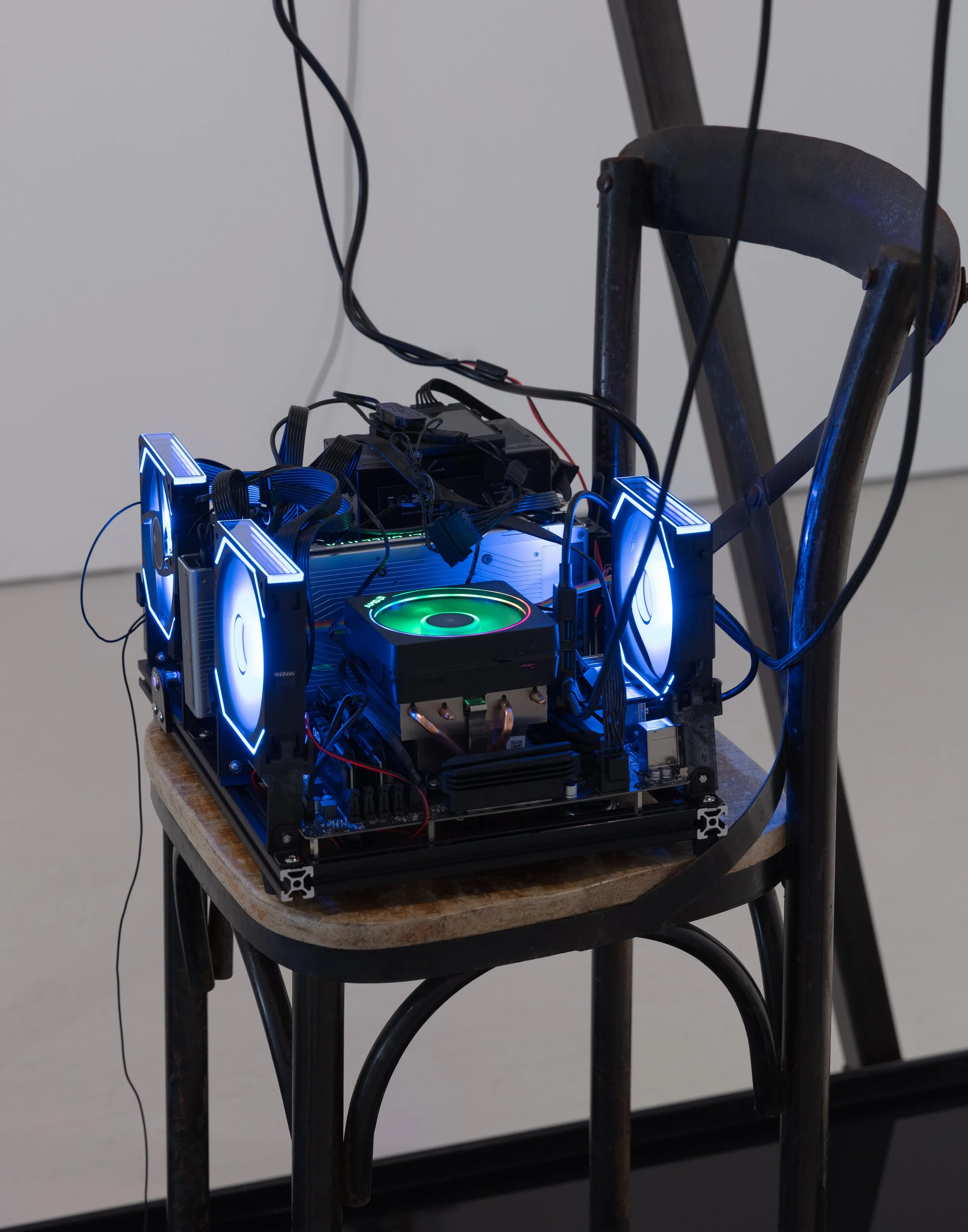
e: We don’t build our works purely by logic; instead, during the process of making we proceed by feel—a sensory sense that “this direction is right.” As the work developed, we increasingly felt that the machine in this piece is a projection of ourselves. Water is spread beneath its feet and a stone hangs over its head. The machine is vulnerable to water, and the whole setup feels in a way like it has been bound so it cannot escape. It must brute-force the decoding endlessly, and if it ever succeeds, it will be destroyed by the stone. That, when you think about it, is a very sad situation—and yet being in this apparently absurd situation somehow resonates with how we feel right now.
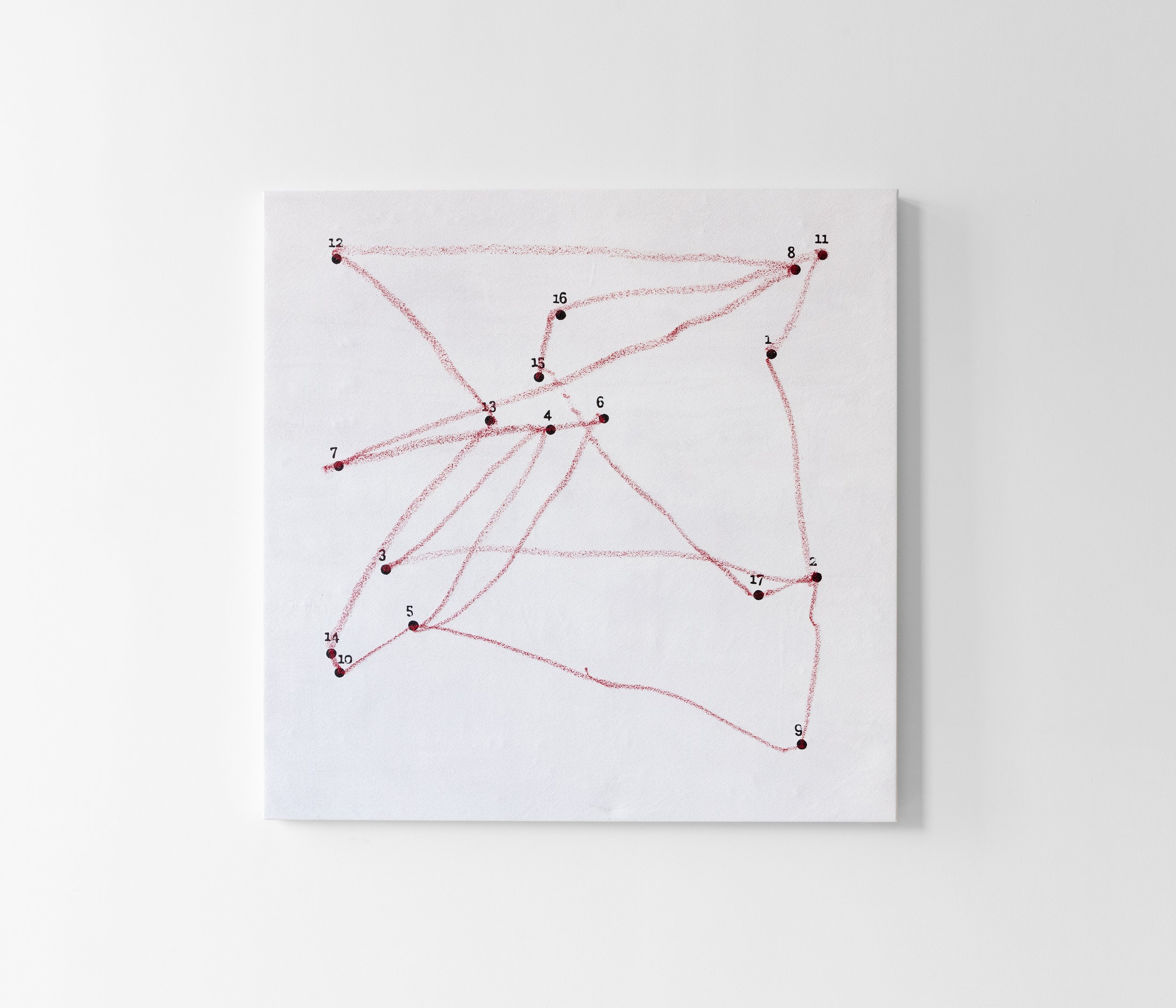
exonemo | Connected the Random Dots (b.2017.06.06), 2025
___________
This interview was originally published in Terminal, the book accompanying exonemo’s exhibition Terminal at NowHere, New York (2026). Copies are available at the gallery.
Jesse Pearson is an American writer and editor. He was editor-in-chief of Vice magazine from 2002 to 2010, and in 2013 he founded Apology, a literary magazine that now also runs as a newsletter and a podcast of long-form interviews with writers, musicians, and artists.
All installation photos by Naho Kubota.